Friday, June 29, 2012

IBE's Online Green Building Certificate Program Concludes


After three years, CSU's Online Green Building Certification Program wraps up, making room for new offerings*. The Institute for the Built Environment (IBE) pioneered the certificate program 7+ years ago when green building was just catching on. Taught by Brian Dunbar and a cadre of local industry professionals, our program experienced overwhelming success in the State of Colorado by offering the certification in a face to face environment. Realizing the need for a larger audience they hired on graduate student Cody Farmer and The Institutefor Learning and Teaching (TILT) to produce, coordinate, and package the education.

The program has grown every offering since 2010, with this most recent class of 28-- some of the best Green Building students ever.  We’ve seen students from Brazil, Japan, Costa Rica, Canada, and Germany to name a few. Classes commonly engage people at all levels of education: Military, Associates, Bachelors, Professional Engineers, Doctorates, and others who have held experienced positions in the construction and real estate fields. All of them energized, intrigued, and ready to pay-it-forward Green Building style.

Students get to banter about LEED navigation, and their frustrations working with the bureaucracy, while at the very same time arming themselves with valuable contributions to help solve those exact problems. There is a refreshing light students gleam around week three, and what transposes into a final report around week 10 (out of 12 weeks) is amazing. Student projects range from outdoor stadiums designed utilizing biomimicry, historic preservation projects informed by principles of sustainability, and high-performing homes designed to thrive throughout time in harsh humidity and weather swings.

The final report, a reflection on a project in its entirety unifies the thought process required for integrated design and sustainable building. At-large, students learn how to participate and identify their own place in the Green Building gamma. Something that we at the IBE call a sense of place. 
Surround yourself in it, and blossom.

*Please note: As a result of the LEED 2012 delay, it is possible this program may be offered one last time in response to demand. Please contact Cody Farmer with your interest.

Student Testimonials:
 “Thanks, Cody. The class was great, and I've decided to take the LEED GA exam soon.  Good luck with the IBE there in Colo.”

 “Thanks Cody, I thoroughly enjoyed the course...even thinking about transferring to the grad program for construction management at CSU.  Keep up the good work!”
 
“Hi Cody, I have enjoyed the course and have been inspired to pursue building differently when residential construction picks up again and I return to General Contractor duties.”

Thursday, June 21, 2012

SoGES Offers Interdisciplinary Graduate Course for Fall 2012: GES-580

The School of Global Environmental Sustainability (SoGES) is very excited to announce the recent addition of a new interdisciplinary course opportunity for graduate students in any discipline on campus. GES-580, Issues in Global Environmental Sustainability, is now open for fall registration, and is designed for graduate students across campus to benefit from the interdisciplinary discussions and lend a unique perspective to the course dialog and curriculum.
This first offering will be taught by Professor Emeritus Brian Dunbar, Director of the Institute for the Built Environment, and will pull together a diversified group of 25 graduate students to help be a model for cross-disciplinary graduate education on campus.
"The concept of sustainability is most successful when simultaneously approached from multiple perspectives," said Professor Brian Dunbar. "Our new graduate course provides a unique forum for expansive learning about current and future opportunities and trends in sustainability."

GES 580 will provide graduate students the opportunity to interact, synthesize and collaborate in a multi-disciplinary learning environment and will promote knowledge synthesis from the diverse programs across campus. Students will achieve a holistic understanding of environmental, social, and economic sustainability through individual research work as well as interdisciplinary collaboration, an essential component to the successful integration of sustainability knowledge.

GES-580 will be run on Wednesdays from 4:00-6:50pm, for questions, please contact SoGES Education Coordinator, Patrick Canavan, at patrick.canavan@colostate.edu.

Monday, June 18, 2012

Campus Crest Communities and SolarCity to Provide Student Residents with Renewable Energy and a Focus on Sustainability

Under One Roof, Solar Projects Unite Young, Ambitious Minds and Clean, Renewable Energy

CHARLOTTE, N.C. & DENVER--()--Campus Crest Communities, Inc. (NYSE: CCG), a leading developer, builder, owner and manager of high-quality, purpose-built student housing under The Grove® brand, today announced a partnership with SolarCity, a national leader in clean energy products and services, to install more than 9,000 solar panels on its student housing communities located in Greeley, Colorado; Flagstaff, Arizona; and Las Cruces, New Mexico. When complete, the initiative will:
“It’s possible for many housing developers to pay less for solar electricity than they pay for utility power and pass on the benefits of clean power to their tenants—SolarCity has completed more than 100 solar projects for housing developments in the U.S.”
  • Provide more than 2.3 million kilowatt-hours of renewable power annually
  • Offset electricity consumption by approximately 50 percent
  • Eliminate over 80 million pounds of annual carbon dioxide emissions, the equivalent of taking approximately 7,000 cars off the road for a year.
 
Ted W. Rollins, Co-founder and Chief Executive Officer of Campus Crest, and Andrew H. Young, Vice President and head of Campus Crest’s sustainability initiative said, “Sustainable living is central to our company philosophy and business practices, and we are pleased to find that our residents are equally as passionate about the concept. Shifting consumption towards clean energy will further our mission to be a leader in regenerative practices by using renewable sources to limit carbon emissions and reduce overall energy costs, which in turn allows us to provide our residents with cleaner, more energy efficient housing.

“This is a great start to our broader commitment to alternative energy and global regeneration, and clearly demonstrates that if you are thoughtful, you can balance economics with environmental and social agendas to create a thriving company. We continue to push our People & Planet initiatives across our platform, and across our industry-leading residence life programs."

“Campus Crest is showing future generations there are better energy options available by giving students access to renewable power,” said Toby Corey, Chief Revenue Officer at SolarCity. “It’s possible for many housing developers to pay less for solar electricity than they pay for utility power and pass on the benefits of clean power to their tenants—SolarCity has completed more than 100 solar projects for housing developments in the U.S.”

Said Josie Plaut, Director of Projects for the Institute for the Built Environment and Executive Director of the Center for Living Environments and Regeneration (CLEAR): “Campus Crest is a great example of seeing today’s business leaders act responsibly and take a balanced approach to drive meaningful results in all areas of their business. We are excited to be involved with them and can see the progress they are making towards acting socially and environmentally responsible while continuing to create strong returns for their shareholders.”

These projects reflect Campus Crest’s commitment to sustainability and making a positive environmental, social, and economic impact on the communities in which it owns and operates student housing developments. To help drive this initiative, the company has partnered with The Institute for the Built Environment (IBE) at Colorado State University, a multidisciplinary institute whose mission is to foster stewardship and sustainability of natural and built environments, and the Center for Living Environments and Regeneration (CLEAR), a 501c(3) non-profit organization focused on global regeneration (www.clearrevolution.org).

About Campus Crest Communities, Inc.
Campus Crest Communities, Inc. (NYSE: CCG) is a leading developer, builder, owner and manager of high-quality, purpose-built student housing properties located close to campuses in targeted U.S. markets. The Company is a self-managed, self-administered and vertically-integrated real estate investment trust which operates all of its properties under The Grove® brand. Campus Crest Communities owns interests in 33 operating student housing properties containing approximately 6,324 apartment units and 17,064 beds and boasts the youngest standardized portfolio in the industry. Since its inception, the Company has focused on customer service, privacy, on-site amenities and its proprietary residence life programs to provide college students across the USA with a higher quality of living. Additional information can be found on the Company's website at http://www.campuscrest.com.

About SolarCity
SolarCity®—a national leader in clean energy products and services—provides homeowners, business and government organizations cleaner, more affordable alternatives to their utility bills. The company makes it simple for customers to lock in lower, long-term rates for clean energy by providing everything from permitting and installation to ongoing monitoring and maintenance. Additional information about the company is available on the Web at www.solarcity.com.

Tuesday, June 5, 2012

DLR Group Green School Research Study Awarded

IBE has partnered with DLR Group to research the cost effectiveness, performance, and human impact of green schools designs. DLR Group is a design firm that provides architectural, engineering, planning, and interior design expertise to clients in the United States and abroad. Their focus is in corporate (mixed-use, hospitality, and workplace), higher education, K-12 education, justice (courts, civic spaces, and detention), and sports design. IBE staff will analyze a variety of schools in different climates to gain a better understanding of how the schools are performing and the impact they have on the occupants. The analysis of these 14 schools will seek to answer the question: Are DLR Group green schools cost-effective, high-performing, and positively impacting students?

Studying the costs and benefits of green schools is exciting as it will help better justify the use of green building practices in future school construction. Qualitative and quantitative data will be collected in order to determine if correlations exist between the attributes of green school and absenteeism, performance, and costs. Identifying these correlations is crucial to the advancement of green school buildings. Decision makers and community members in school districts across the county need studies like this to inform their decisions concerning future school construction. It is the hope of DLR Group and IBE that this research will offer insight and direction in order to further the advancement of efficient and healthy learning environments. (Photo: Marysville (Wash.) Getchell Campus credit of DLR Group)


Thursday, May 3, 2012

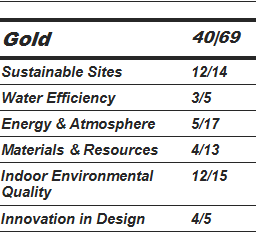
Vail Fire Station #3 Achieves LEED Gold Certification


POC: April Wackerman
Resources: Report and Press Release - March 2012
Uploaded: May, 3, 2012


The Town of Vail and Vail Fire and Emergency Services are extremely proud to have achieved a LEED Gold certification for the new West Vail Fire Station # 3. Vail has embraced environmental sustainability and the construction of the new fire station was one of the first projects in which we collaborated with the Institute for the Built Environment. Our project was not only a success, but we enjoyed the learning process along the way. Our Architect, Belford-Watkins Architect Group, was very knowledgeable and invaluable in the LEED process. As one of only five fire stations in Colorado to achieve LEED certification, we are thrilled to be leading by example and reaping the benefits of exceptional energy savings.” –Mark Miller, Fire Chief.
The Town of Vail, CO. has just opened its newly LEED Gold Certified Fire Station and as stated above it is one of only five in the entire state of Colorado to achieve this level of efficiency in building, design, and construction.  Much of the credit is due to the diligence of the designers and contractors who were able to recycle 91% of the construction waste to keep it from going to the landfill.  16% of the materials used in construction were regionally sourced with an additional 10% of the materials containing recycled content.  By setting design and construction goals early in the project planning process, the team was able to reach some amazing efficiencies.

·         Highly efficient indoor water fixtures have reduced the daily water consumption by 41% compared to a typical building.  

·         High performance glazing, daylighting, lighting controls, increased R-values in the roof and walls, and other features contribute to the superior energy performance of the building, allowing it to perform over 21% better than a similar building built to code.

·         Daylighting throughout 99% of the building reduces energy consumption and improves the quality of the indoor environment. 

·         Low VOC adhesives, paints, and carpets increased the air quality of the indoor environment.
·         The Town of Vail has also decided to purchase Renewable Energy Credits (RECs) to offset 70% of the estimated electricity needs of the building for 2 years.
The building is a 15,000 square foot facility which includes housing to accommodate up to 12 firefighters and modern training facilities.   These modern professional training facilities are state-of-the-art apparatuses designed to increase the effectiveness of fighting fires in the high rise multiple occupancy structures.   
The location of the building is conveniently located close to alternative transportation corridors and access points giving it a high profile and adding to its appeal for the town.  It serves as an educational center piece by displaying panels that detail the green design elements of the building.  Visitors, students, and staff gain valuable insight and understanding by experiencing the building and reading about the techniques that went into the design and construction of the building.  In addition, Graduate student interns with the Institute for the Built Environment were directly involved in the LEED coordination and documentation process. Graduate students from the Departments of Construction Management and Interior Design participated and guided the LEED certification process.  These real-world project experiences are invaluable educational tools that not only help students understand the LEED process but give them a leg up in our extremely competitive employment environment.
Funding for Vail Fire and Emergency Services Station 3 was provided by the Town of Vail general fund reserves and from the Capitol Project Fund.

Thursday, April 19, 2012

Green and Gold…and More Green: Alumnus Discusses the Green Start He Got at CSU

By Katie Boeder

We often speak of alumni “bleeding green and gold”, but in the case of John Mlade, he has an extra dosage of green in his blood. A 2005 Masters of Science graduate in Construction Management, John led a green building movement on campus and beyond.

“It’s not just what I needed to do, it’s what I wanted to do,” explains John. “The opportunity was there.”

John joined the Colorado State University campus after completing his undergraduate degree in biological conservation and geography from the University of Wisconsin Madison. “I knew I was interested in environmental building, and I was looking for a place that fit,” explains John, on why he chose CSU for his graduate schooling.

He soon found himself in the office of Brian Dunbar, professor and director of the Institute for the Built Environment, a multidisciplinary institute whose mission is to promote stewardship and sustainability of natural and built environments through research-based, interdisciplinary educational forums. John became a graduate research associate with IBE and founded the National Committee of the U.S. Green Building Council’s Emerging Green Builders, a student and young professional group that fosters industry growth and transition in the green building industry.

“John was one of the first IBE graduate interns who has benefitted from CSU’s land grant mission of serving communities in Colorado and beyond. While at IBE, John conceived ideas for our first LEED projects, including Fossil Ridge High School,” explains Brian.

While a graduate student, he also developed and taught multiple courses on sustainability across CSU. In 2004, he was awarded the Colorado State University Campus Sustainability Award. “By the time I graduated, most graduate students in the Department of Construction Management were studying green building,” explains John, who also had the opportunity to lead the green renovations at Guggenheim Hall, which houses the Department of Construction Management. “The classrooms were some of the earliest green projects on campus and served as an excellent service learning project led by Brian Dunbar.”

When talking to John about CSU, it is hard for him to tell a story without mentioning Brian. “He’s got a soft-guiding hand and is great at empowering students to think. He participates in the journey, asks questions, and enables the students to discover,” says John. “My respect for Brian and the IBE runs deep.”

In May of 2010, John had the opportunity to come back to Fort Collins and join forces with Brian and IBE to participate in their new regenerative design research. “Their current Living Environments in Natural, Social, and Economic Systems (LENSES) project is exceptional by nature and has the potential to transform the industry,” adds John.

Following in Brian’s footsteps, John is well on his way to transforming the industry also. As a national sustainable design leader at Perkins+Will, one of the largest architecture firms in the country, he facilitates sustainable design with some of the largest planning, engineering and construction companies in the world. John is responsible for over 22 million square feet of LEED registered building across the globe…and counting.

“John continues to be a pioneer, greening top projects around the world,” adds Brian. “John is a living example of the promise of our land grant mission and CSU’s strong commitment to sustaining our planet.”

In recent years, John has been an impactful donor to the IBE. “I feel like I owe so much to IBE for where I am,” he explains. “I want to help support students and the special projects that provide such important hands-on experience.”

His passion for helping students become the future leaders in sustainable building runs deep…as deep as his green and gold. In his words: “Do what you love and then make it green.”