Showing posts with label Beyond Sustainability. Show all posts

Tuesday, November 4, 2014

Food Waste Decomposition Systems

By: Cassandra Kliewer 

Sustainable Associate

Josie Plaut 

Associate Dirtector


Food Waste

In 2010, America wasted an estimated 34 million tons of food and only about 3% of that waste was diverted from landfills. Food
digesters, which turn food waste into compost and gray water, are especially well-suited for large commercial kitchens like those found in hospitals and university campuses. Instead of putting food waste into landfills, food digesters turn waste food, into new soil and reduce the burden on municipal waste water treatment facilities.  Two waste audit studies, conducted by The Institute for The Built Environment for Rocky Mountain National Park, show that between 16-30% of the park’s waste, by weight, is food waste.

Food Digesters

Food digesters can either work with or without water. Both systems use an additive to accelerate the process of decomposition. Normally, the decomposing process would take a month, but instead the additive processes the food in 24 hours. The water-based process produces compost and gray water, which is water that is similar to the waste water from sinks and showers.  In a building that is connected to a municipal waste water treatment facility, gray water is easily treatable by the municipal waste water systems.  Gray water can also be treated on site and used for things like landscape irrigation.  Conversely, the dry system is evaporation-based and food waste is mixed with a decomposing additive. Both systems provide easy and sustainable solutions to landfill waste.
Food digesting systems produce nutrient rich material that can be used as compost to fertilize soil for landscapes. Since the dry system can digest food within 24 hours, a rapid source of compost for landscaping is readily available. If the building does not need compost, the facility can reach out to the community and provide compost for landscaping purposes elsewhere. Another benefit of having a food
digester is that it reduces the amount (and cost) of waste that would normally go to a landfill. Since food waste is composted on site with a food digester, there is also a benefit to reduced transportation cost and emissions.  In addition to saving dollars and emissions, and perhaps most importantly, wasted food is kept in the nutrient cycle to rebuild soil and is kept out of landfills where it contributes to methane gas production.

The Future of Food Waste

Various government officials have noticed the impact of food waste and are taken measures against food waste.  Massachusetts has taken measures to ban food waste from big food wasters (schools, hospitals, grocery stores, etc.) in favor of more sustainable options such as composting and using waste food as animal feed.  The ban aims to reduce landfill waste and improve soil health by prohibiting businesses from throwing-away leftovers into landfills.  Vermont and Connecticut have similar legislation in place.  The future where we universally turn leftovers into soil amendment, may be just around the corner!

Tuesday, November 5, 2013

Technology Backing Traditional Wisdom in Sustainable Construction


People often think of sustainable construction as if it was a new concept, when in reality it is the concept of wastefulness in construction that is novel. Throughout much of history people built their homes with environmentally benign materials that were locally sourced and readily available out of necessity.  Over time, it was discovered that using certain designs, orientations, material choices, and construction methods could lead to homes that maximized comfort and functionality for residents.   

For example, Ancient Syrians discovered that they could construct beehive shaped mud huts that would keep them cool in their hot, arid desert climate.  The mud used to build these huts has a relatively high thermal mass so it is slow to absorb or release energy. Few or no windows prevent radiant heat gains in the huts. A small hole in the center of the elevated ceiling allows for hot air to rise and escape the structure. This leads to these structures staying cool during the day and somewhat warm at night. 
Cliff dwellings constructed by the Pueblo Indians are another great example of using natural surroundings and passive design strategies to maximize comfort.  Entire villages constructed out of stone have been discovered built into southern facing cliffs and nestled underneath natural rock overhangs.  These overhangs effectively minimize unwanted direct solar heat gain during the summer months while allowing for much needed heat gains the winter months.  The rock overhang also provides residents with protection from rain and snow.  

While it is not practical for everyone to have a stone house built into the side of a cliff, nor do most westerners want to live in a mud hut, it is possible to use a higher percentage of locally sourced materials and take advantage of passive design strategies to optimize the performance of your building.

As written by the ancient Greek philosopher Aeschylus, “Only primitives & barbarians lack knowledge of houses turned to face the winter sun.”  

But as I walk through my neighborhood it seems as though houses were dropped on their site with no consideration of the buildings orientation. 

So has the technological “advancement” of the human race somehow caused us to revert primitives and barbarians without enough sense to even attempt to take advantage of the free energy from the sun? Are we content relying on the brute strength of our HVAC systems to regulate our comfort instead of taking advantage of the synergistic opportunities of good design and construction.

Sure, technology certainly has the potential to enhance the comfort and functionality of homes but it often comes with negative impacts on the environment and consequently, our health.

I assert that technology must not take place of previously developed designs & construction methods that we now refer to as “sustainable,” rather it should be used to optimize and build upon these previously established construction principles.

In the past, building designs were refined and optimized from the process of trial and error over many years.  Now software exits capable of running building performance simulations to give us a better idea of they will perform before we construct them.  These simulations allow us to better understand how a variety of factors such as climate, building orientation and design, material selection and construction methods impact a building’s ultimate performance. 

In addition, advancements in windows, air sealing techniques, and insulation have made building more efficient houses even easier than ever before. 

Even something as simple as landscape considerations can positively impact the performance of your building. 

Passive design, when done properly, can reduce the need for mechanical heating and cooling and allow for HVAC systems to be scaled down.

In conclusion, there is no denying that technology is here to stay; however, we should not solely rely on technology for our comfort.  Past cultures have proven that thoughtful design can produce structures that make the best out of natural surroundings.  Technology should build upon passive design strategies instead of being use in lieu of passive strategies. Thoughtfully designed and constructed houses do not have to cost more than an average house and will use considerably less energy. To me, this is an obvious choice. 


Sunday, June 16, 2013

Is Sustainability Just a Buzzword?

Brody Hatch, IBE Sustainable Building Associate


Sustainability may seem more like a buzz-word than an actual concept or way of doing business.  Words like green, sustainable, renewable, earth-friendly, etc. have become taglines that lead to varying reactions by different people.  I often talk with people that believe that sustainability in business, economic development, and energy production are just passing fads. They are unaware of the impact, influence, and prominence of these concepts in the world.  So how big is sustainability anyway?  The following are some simple facts about the growth of the sustainability movement in various forms.

LEED in the World
USGBC
Green building materials demand has grown exponentially over the past several years and is expected to continue to grow by 11% annually through 2017.  As the cost of green building materials has fallen, demand for said products has increased due to the undisputed advantages of green building.  In many cases, green building has been shown to be just as cost effective as traditional building, with the additional benefits of significantly lower utility and maintenance costs.

Renewable energy sources account for almost 20% of global energy production.  Obviously, some countries are doing more than others.  The following countries and regions are the top ten renewable energy producers in the world (ordered from highest producer to lowest): China, EU, USA, Brazil, Canada, Russia, India, Germany, Norway, Japan, and Spain.  The amount of renewable energy produced is growing rapidly.

Wind capacity has grown by over 25% annually for the last five years.  It’s hard to drive anywhere (at least in the western US, but I imagine elsewhere as well), without seeing huge wind farms.   With the technology improvements, and costs decreasing, wind power is becoming more and more profitable.

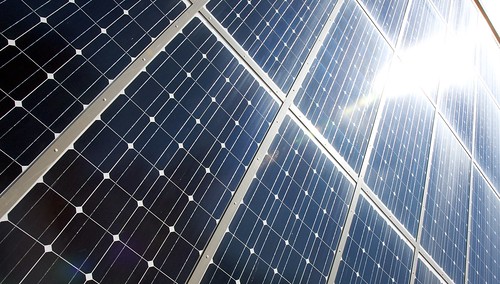
Solar power production has grown 50% annually for the last five years.  This rapid growth, again, is due in large part to the decreasing cost of production and installation of solar panels.  Panels are also becoming ever more efficient in their energy production.
Flickr.


Biofuel (including ethanol and biodiesel) production has increased by 20% annually for the last ten years.  For some countries, this is nothing new.  I lived in Brazil for a couple of years between 2004 and 2006.  I was surprised to find that ethanol was not only common, but in certain areas, used more often than petroleum fuel in cars, buses and trucks.  Several decades ago, when many parts of the world were uncovering petroleum oil deposits, Brazil was unable to discover any within their borders.  Rather than become dependent on other countries for their energy needs, Brazil invested heavily in the research and production of sugarcane ethanol.  Today, the industry is booming and provides a large quantity of the fuel that is consumed in the country and exported outside its borders.

Sustainability in construction and energy production are more than theoretical concepts, they are here to stay.  In a lot of cases, people are unaware of the rapid growth of sustainability that is occurring in construction and energy production as it is happening behind the scenes.  We still have a long way to go but I am optimistic that given the current trends and projected growth, eventually sustainability will cease to feel like a buzz-word and become an everyday way of life.

Friday, April 26, 2013

TEDx FrontRange: ELEVATE!

Josie Plaut
The theme this year for Tedx FrontRange is “Elevate.” In the spirit of the pioneering west, a group of fun and engaging speakers (and performers!) will share the ways that they are exploring new frontiers, guiding and inspiring others, and driving innovation.  IBE’s Associate Director, Josie Plaut, will share her ideas on how to go beyond notion of sustainably and toward future that is powered through regeneration.  Simply stated, regeneration is about investing in our future by creating and restoring natural, social and economic capital.  We achieve this through expanding health, vitality and equity in our personal and professional lives. 

Date: May 31, 2013, 1-5pm
Location: Rialto Theater Center, Loveland, CO


Website
Tickets
Facebook
Twitter


More on regeneration….

In recent years, the green industry has introduced a myriad of new tools, products, and standards that help to reduce environmental impacts and encourage more sustainable practices – important steps in the right direction.  Unfortunately, current economic models still rely heavily on depleting natural capital.  Further, the burden to process, manufacture, and sell products is often at the expense of human health and wellbeing.  Here, at a pivotal moment in society, we have the opportunity to change course.  If we are to solve the looming environmental and social crises in time, we must move from using less to creating more. Regeneration is the practice of aligning human activities to give new life, strength and vigor to natural, social, and economic systems. It goes beyond green or sustainable thinking, generally focused on reducing harm, toward a model built on renewal and revitalization.

Regeneration means rebuilding depleted ecosystems, like the Mississippi river delta, or simply riding your bicycle.  It can be a vitalizing urban redevelopment project or the renewal of soils and farming practices in your own garden. Regeneration has many faces, but one purpose: finding what’s broken and creating solutions that are additive, positive and contributive. By shifting mindsets from sustainability to regeneration, we can secure a thriving future for many generations to come.  This paradigm shift is not only necessary, but it is inspiring, refreshing and positive.