Thursday, April 19, 2012

Green and Gold…and More Green: Alumnus Discusses the Green Start He Got at CSU

By Katie Boeder

We often speak of alumni “bleeding green and gold”, but in the case of John Mlade, he has an extra dosage of green in his blood. A 2005 Masters of Science graduate in Construction Management, John led a green building movement on campus and beyond.

“It’s not just what I needed to do, it’s what I wanted to do,” explains John. “The opportunity was there.”

John joined the Colorado State University campus after completing his undergraduate degree in biological conservation and geography from the University of Wisconsin Madison. “I knew I was interested in environmental building, and I was looking for a place that fit,” explains John, on why he chose CSU for his graduate schooling.

He soon found himself in the office of Brian Dunbar, professor and director of the Institute for the Built Environment, a multidisciplinary institute whose mission is to promote stewardship and sustainability of natural and built environments through research-based, interdisciplinary educational forums. John became a graduate research associate with IBE and founded the National Committee of the U.S. Green Building Council’s Emerging Green Builders, a student and young professional group that fosters industry growth and transition in the green building industry.

“John was one of the first IBE graduate interns who has benefitted from CSU’s land grant mission of serving communities in Colorado and beyond. While at IBE, John conceived ideas for our first LEED projects, including Fossil Ridge High School,” explains Brian.

While a graduate student, he also developed and taught multiple courses on sustainability across CSU. In 2004, he was awarded the Colorado State University Campus Sustainability Award. “By the time I graduated, most graduate students in the Department of Construction Management were studying green building,” explains John, who also had the opportunity to lead the green renovations at Guggenheim Hall, which houses the Department of Construction Management. “The classrooms were some of the earliest green projects on campus and served as an excellent service learning project led by Brian Dunbar.”

When talking to John about CSU, it is hard for him to tell a story without mentioning Brian. “He’s got a soft-guiding hand and is great at empowering students to think. He participates in the journey, asks questions, and enables the students to discover,” says John. “My respect for Brian and the IBE runs deep.”

In May of 2010, John had the opportunity to come back to Fort Collins and join forces with Brian and IBE to participate in their new regenerative design research. “Their current Living Environments in Natural, Social, and Economic Systems (LENSES) project is exceptional by nature and has the potential to transform the industry,” adds John.

Following in Brian’s footsteps, John is well on his way to transforming the industry also. As a national sustainable design leader at Perkins+Will, one of the largest architecture firms in the country, he facilitates sustainable design with some of the largest planning, engineering and construction companies in the world. John is responsible for over 22 million square feet of LEED registered building across the globe…and counting.

“John continues to be a pioneer, greening top projects around the world,” adds Brian. “John is a living example of the promise of our land grant mission and CSU’s strong commitment to sustaining our planet.”

In recent years, John has been an impactful donor to the IBE. “I feel like I owe so much to IBE for where I am,” he explains. “I want to help support students and the special projects that provide such important hands-on experience.”

His passion for helping students become the future leaders in sustainable building runs deep…as deep as his green and gold. In his words: “Do what you love and then make it green.”

Wednesday, April 11, 2012

Institute for the Built Environment receives Catalyst Award

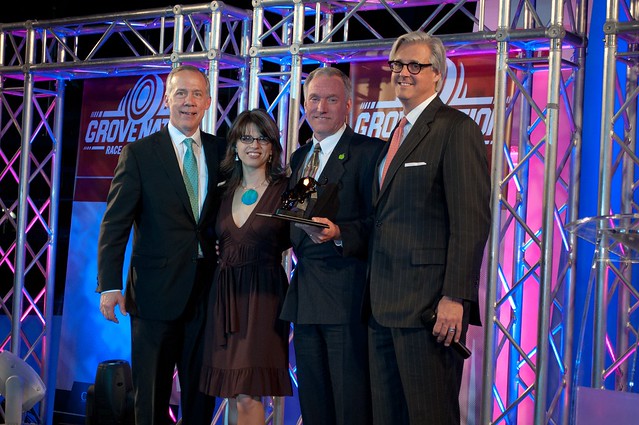
Campus Crest Communities, a publically traded developer of campus student housing, awarded the Institute for the Built Environment based in the College of Applied Human Sciences at Colorado State University, with the Catalyst Award at its annual meeting.  Campus Crest is based in Charlotte, North Carolina, and since 2007 has built more than 30 student communities at universities across the country.  In recognizing IBE, the CEOs of Campus Crest, Michael Hartnett and Ted Rollins, acknowledged the transformation that is taking place within the 500-employee company.  Hartnett and Rollins recounted how the transformation began – while they were in the planning process for their project near the Colorado StateUniversity campus, a neighbor suggested that Fort Collins would be more accepting of their development if they would make it their first green community.

When asked to help them ‘green’ their Fort Collins project, Brian Dunbar and Josie Plaut, directors at IBE, required Campus Crest to agree to company-wide sustainability training, pursuit of LEED certification for their Fort Collins project, and a re-design of their prototype design to be applied at other upcoming developments. Campus Crest agreed to each condition and now plans to incorporate increasing levels of sustainable development, sustainable operations, corporate sustainability and on-going sustainability training to their employees and the more than 18,000 student residents in their communities.

Thursday, March 29, 2012

Colorado State University School of Global Environmental Sustainability Spring Symposium

In the US the largest portion of greenhouse gas (GHG) emissions do not originate from cars & trucks; they originate from residential, commercial and industrial buildings which together constitute the built environment.

Come to the Colorado State University School of GlobalEnvironmental Sustainability Spring Symposium to hear presentations about how assessment, standards, and measurement tools can reduce carbon emissions in the built environment.

Revolutionary architectural pioneer and founder of Architecture 2030, Ed Mazria, will explain how American citizens can enable pathways to carbon neutral towns and cities in his presentation of, “The Next Built Environment Today.”  

Rocky Mountain Institute (RMI) principal and founder of Green Step, Dr. Victor Olgyay, will present “Design for Climate: Buildings with Nature’s Metabolism.

Dr. Scott Denning, CSU Monfort Professor and a Director at the National Science Foundation Center for Multiscale Modeling of AtmosphericProcesses (CMAAP) will present “Climate Change: It’s worse than you think, but it is not the end of the world.

Also, join in cross-disciplinary, cross-cutting breakout groups and panel discussions focusing on the future of a carbon neutral built environment.

Who: Host, Carbon Footprint Metric for the Built Environment and Keynote Speakers, Ed Mazria, Dr. Scott Denning, and Dr. Victor Olgyay
When: April 27th at 8:30am (check in begins at 7:30am)
Where: Lory Student Center, Room 230

Registration is required. To register, please visit www.sustainability.colostate.edu/cfm


Wednesday, September 28, 2011

The Berry Prairie: Native Biodiversity in a Rooftop Landscape

A current project of the Institute for the Built Environment, the Berry Center at the University of Wyoming, recently completed an extensive vegetative roof.   The University of Wyoming filled the vegetative roof with plant species found within a 40 mile radius of Laramie.  This roof is a prime example of a building being used as a research and teaching tool.  To read more about the components of the roof, and how it is being used by UW professors and students, visit their blog: http://berryprairie.blogspot.com


Monday, September 19, 2011

Planning to attend Greenbuild?

We hope you will join us Wednesday, October 5th for Green Schools that Teach: Whole-School Sustainability


Abstract
What constitutes a successful green school? Through a nationwide research study, we are learning that success involves more than innovative green building. A high-performing green school should also be a teaching tool by actively engaging users. Several green schools that have integrated sustainability and green building within their core curricula were analyzed. The results of this study will showcase the various methods, processes, and resources used to create learning environments that actively 'teach' all building users.


Presenters
Stephanie Barr, M.A. LEED AP BD+C
Green School Specialist, IBE
Katharine Leigh, Ph.d. LEED AP BD+C
Professor, Department of Design & Merchandising, CSU
Brian Dunbar, M.Arch. LEED AP
Executive Director, IBE

Thursday, September 1, 2011

High Performing Schools on the way for Laramie County School District

Recently, the Institute for the Built Environment kicked off a “High Performing Schools” project with the Laramie County School District, based in Cheyenne, WY.  The green schools project will bring together teachers, students, administrators and community members to collectively envision how all schools in the district can be more energy efficient, employ renewable energy strategies, increase water efficiency, reduce waste, and create healthier school environments. 

IBE will be involved in teaching district teachers how to use their school building and grounds to teach about sustainability, work with students to understand the potential of clean energy and other emerging fields of study, and help school facilities staff to discover ways to increase efficiencies in their new and existing schools.